





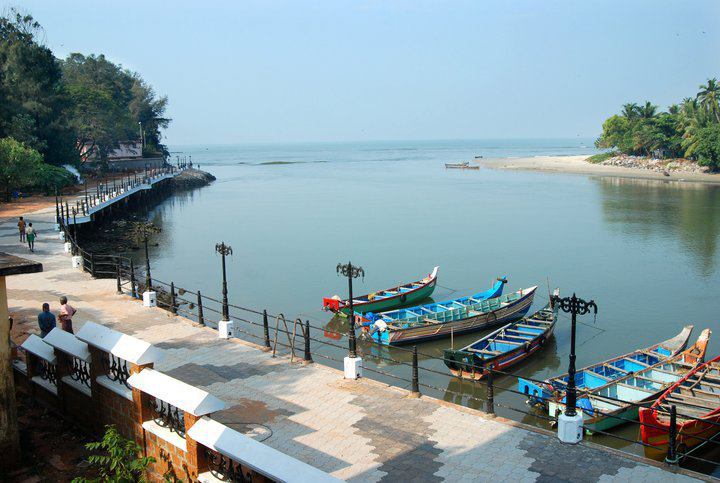
My Evergreen Native City - Mahe
Mahé,[1] natively known as Mayyazhi, is a small town at the mouth of the Mahé River and is surrounded on all sides by the State of Kerala. The Kannur District surrounds Mahé on three sides and Kozhikode District from one side. Formerly part of French India, Mahé now forms a municipality in Mahé district, one of the four districts of the Union Territory of Puducherry. Mahé has one member (MLA) in the Puducherry Legislative Assembly Before the incursion of European colonial powers into India, this area was part of Kolathu Nadu which comprised Thulunadu, Chirakkal and Kadathanadu. The French East India Company constructed a fort on the site of Mahé in 1724, in accordance with an accord concluded between André Mollandin and Raja Vazhunnavar of Vatakara three years earlier. In 1741, Mahé de La Bourdonnais retook the town after a period of occupation by the Marathas. In 1761 the British captured Mahé, and the settlement was handed over to the Rajah of Kadathanadu. The British restored Mahé to the French as a part of the 1763 Treaty of Paris. In 1779, the Anglo-French war broke out, resulting in the French loss of Mahé. In 1783, the British agreed to restore to the French their settlements in India, and Mahé was handed over to the French in 1785.[4] Mahé in 1726. Map made after taking possession of the place and the war against the Indian king of the region supported by the British On the outbreak of the French Revolutionary Wars in 1793, a British force under James Hartley captured Mahé. In 1816 the British restored Mahé to the French as a part of the 1814 Treaty of Paris, after the conclusion of the Napoleonic Wars. Mayyazhi remained under French jurisdiction as a small French colony, an enclave within British India, during the long span that began in 1816. After the Independence of India the area continued to be French-ruled until 13 June 1954, when a long anti-colonial struggle culminated in its joining the Indian Union (see Causes for liberation of French colonies in India). After the French left, Mahé became a Sub-Division of Puducherry Union Territory. The area of Mahé begins from Mayyazhi puzha in the north to Azhiyoor at the south. Mahé consists of Mahé town and Naluthara, which includes four villages: Pandakkal, Pallur, Chalakara and Chembra. The ruler of Kingdom of Mysore from the 1760s, Hyder Ali (ca 1722–1782), gifted Naluthara to the French as a token of appreciation for the help they gave in opposing the British. Liberation of Mahe Gandhians like I. K. Kumaran led the freedom struggle in Mahe after India became an independent country in 1947. The Municipal office of the French administration was attacked by 9.00 p.m. on 21 October 1948. The French national flag was removed by the freedom aspirants and the Indian national flag hoisted on the building called Merri in French. On the 26th October, the French navy ship anchored in Mahe and the French recaptured the control of Mahe. The ship left Mahe on the 31st of October. Communists tried to capture Cherukallayi enclave in April 1954. Two Indians were killed during the struggle. Indian flag was hoisted in the Naluthura enclave on the first of May. The freedom fighters conducted an embargo on Mahe from June that year. On the 14th July, 1954, the Mahajanasabha organized a March into Mahe and Mahe was liberated on the 16 July 1954. Mahé's nearest airport is Calicut International Airport, Karipur, at a distance of 85 km; Kannur Airport under construction is nearing completion at Mattannur at a distance of 40 kilometres (25 miles). The nearest Railway Station is Mahé, where a few local and express trains stop. The nearest major railway stations, where several long distance trains stop, are Thalassery, Kannur, Mangalore and Vatakara.


|