


Kostnice of Kutná Hora - paradise for goths
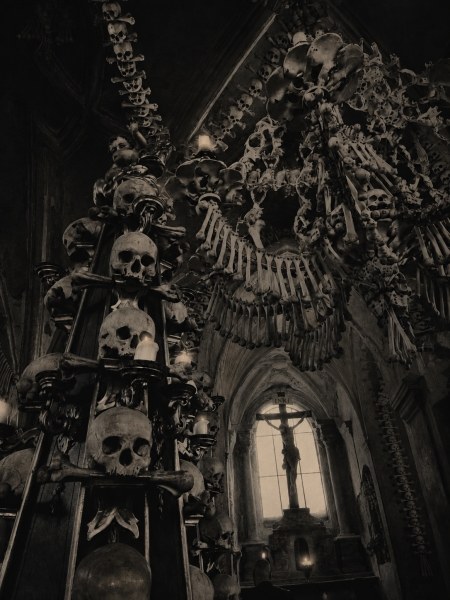
The Sedlec Ossuary: Czechia’s Church of BonesDeep beneath a small chapel in Kutná Hora, Czechia, lies one of the most unusual and haunting places in the country: the Sedlec Ossuary (Sedlecká kostnice). Unlike an ordinary church decorated with paintings or sculptures, this one is decorated with something far more macabre — the bones and skulls of thousands of people.The ossuary is located beneath the Cemetery Church of All Saints in Sedlec, a historic part of Kutná Hora. The story of the site goes back to the 13th century, when, according to tradition, the abbot of the local Cistercian monastery returned from Jerusalem carrying soil from Golgotha, the place traditionally associated with the crucifixion of Jesus. He scattered the soil over the local cemetery, making it a highly desirable place to be buried. The cemetery eventually became one of the most famous burial grounds in Central Europe.Over the following centuries, thousands of people were buried there. Wars, epidemics and the ordinary passage of time caused the cemetery to become increasingly crowded. When parts of the cemetery were reorganised and the church was rebuilt in the late Middle Ages, many of the older remains were placed in the underground ossuary.The bones remained there for centuries, but the ossuary took on its present extraordinary appearance in the 19th century. The Schwarzenberg noble family commissioned woodcarver František Rint to organise and artistically arrange the remains. He created some of the site’s most famous features, including a huge chandelier made from human bones, decorative pyramids of skulls and bones, and even the Schwarzenberg family coat of arms.It may seem like something from a horror film, but the purpose is not simply to frighten visitors. The ossuary reflects the old European tradition of memento mori - a Latin expression meaning “remember that you must die.” Medieval and early modern European culture often used images of skulls, skeletons and decaying bodies to remind people that wealth, beauty and social status are temporary, and that death ultimately comes for everyone.Today, the Sedlec Ossuary contains the remains of an estimated 40,000–60,000 people. Despite its dark appearance, it is also a place of remembrance. The bones once belonged to ordinary people who lived, loved, worked and died many centuries ago. Seeing them arranged so carefully creates a strange contrast between the macabre and the beautiful.The ossuary is part of the historic area of Kutná Hora, which is a UNESCO World Heritage Site. Kutná Hora itself was once one of the richest towns in the medieval Kingdom of Bohemia, thanks to its silver mines. So if you ever visit the ossuary, it is worth exploring the rest of the town as well.A few curious facts:• The famous bone chandelier contains examples of almost every bone in the human body.• The ossuary’s decorations were created from real human remains rather than replicas.• The Schwarzenberg coat of arms includes a rather unusual detail: a raven pecking at the eye of a skull.• The site is not unique to Czechia, ossuaries exist elsewhere in Europe, but the Sedlec Ossuary is probably the most famous example because of the elaborate way the bones were arranged.• Despite its appearance, the ossuary is a consecrated Christian site rather than simply a macabre attraction.Perhaps the strangest thing about Sedlec is that its message is both unsettling and strangely universal. Beneath the elaborate chandelier and thousands of skulls, there is a very simple idea: everyone is mortal.And perhaps that is why the Sedlec Ossuary has remained so fascinating for centuries. It doesn’t only tell us about death, it tells us how people in the past tried to understand it.
|